




Altitude
Arequipa 2,335 m, gentle
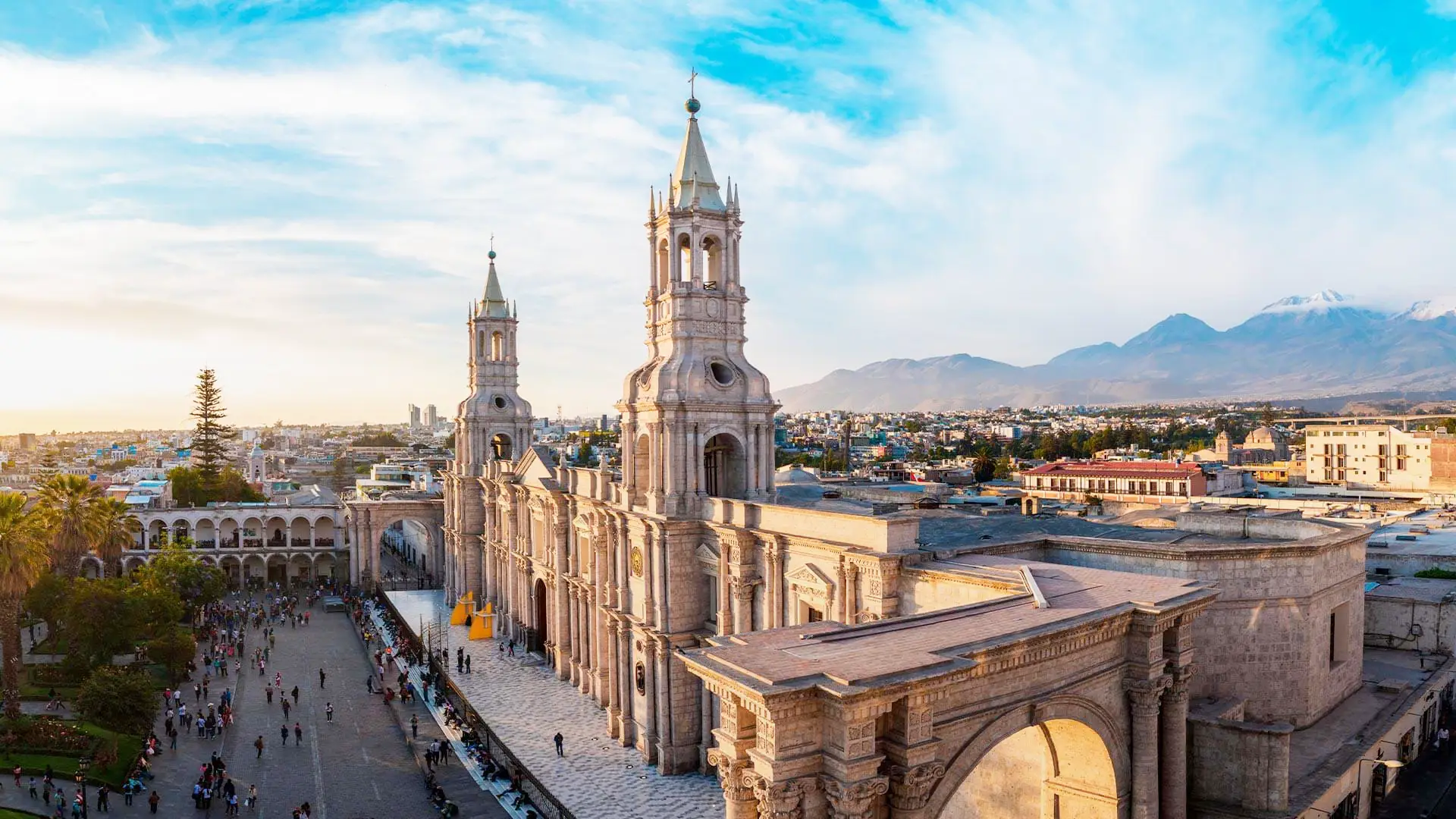
The white volcanic city beneath three snow peaks, and a canyon twice the depth of the Grand Canyon where condors ride the morning air. The grand finale of the Peruvian south.
Arequipa is Peru's proud second city, built almost entirely from sillar, a white volcanic stone that glows in the high desert light and gives the place its name, the White City. Set beneath the perfect cone of El Misti and two more volcanoes, it has a magnificent colonial heart, a walled convent city you can lose an afternoon in, a famous and fiercely independent kitchen, and an altitude gentle enough that many travelers use it to ease into the southern highlands.
A few hours north lies its great companion, the Colca Canyon, more than twice as deep as the Grand Canyon, its walls stepped with terraces still farmed by the Collagua people in their bright embroidered dress. At a bend in the rim each morning, Andean condors, among the largest flying birds on earth, lift off the cliffs and circle the thermals close enough to hear the wind in their wings. Together, city and canyon make the richest corner of the south, and this is the guide to them.
Two very different worlds a few hours apart, that we link into one unforgettable stretch of the south.
A walled convent the size of a small town, founded in 1579, with ochre and cobalt lanes, courtyards and cloisters, a city sealed within the city for four centuries.
The colonial center of glowing sillar stone, the grand Plaza de Armas and Cathedral, a UNESCO World Heritage core best walked slowly in the late light.
The remarkably preserved frozen body of an Inca girl offered to the mountain gods five centuries ago, found on a nearby volcano and kept in the city.
The viewpoint where condors rise off the canyon walls each morning on the warming air, gliding close overhead. One of the great wildlife sights of the Andes.
Stepped terraces, white-walled villages and the Collagua and Cabana communities in their embroidered dress, with hot springs to soak away the road.
El Misti, Chachani and Pichu Pichu on the skyline, and one of Peru's great regional cuisines in the old picanterias of the city.
The honest, practical detail for the city and the canyon together.
Arequipa has its own airport, around an hour and a half from Lima and an hour from Cusco, so most travelers fly in. The city itself is the base, and the Colca Canyon lies some three to four hours north by road, a scenic drive that climbs over a high pass above 4,800 meters, with vicuna on the plains and volcanoes all around, before dropping into the canyon villages.
Because the canyon sits considerably higher than the city, and the condors fly best at first light, we almost always have you stay overnight in the Colca rather than attempt it as a long day trip. It is also a natural overland link between Cusco, Lake Titicaca and the coast.
The dry season, from May to November, is the clearest and most reliable window, with sunny days, cold nights and the best conditions for the canyon and the condors. Arequipa enjoys a famously sunny climate for much of the year, often described as the city of eternal blue sky.
The rainy season, from December to March, brings cloud and afternoon showers to the highlands, and the canyon road can occasionally be affected. The condors are present year-round, but clear, dry mornings give the best viewing, which is another reason the dry months are ideal.
The condors are the reason most people make the journey, and they reward it. At the Cruz del Condor viewpoint, as the morning sun warms the canyon, Andean condors lift from their roosts on the cliffs and ride the rising thermals, often passing within meters of the rim, vast and silent on three-meter wings. It is a genuinely moving sight, and the timing matters: we get you there early, before the buses, for the best of the morning flight.
Beyond the condors, the canyon itself is the draw, one of the deepest on earth, its terraced flanks farmed for over a thousand years, dotted with old villages and warm springs, and far quieter the further in you go.
Plan on three to four days for the pair. One to two days suit Arequipa, the monastery, the center, the museum and a long lunch, with time to enjoy the gentle altitude. Then one to two days for the Colca, driving up, overnighting in the canyon, and rising early for the condors before exploring the villages and terraces. Done together, city and canyon make a beautifully balanced few days.
In Arequipa, the loveliest places are converted colonial houses of sillar stone in or near the historic center, all courtyards and thick cool walls. In the Colca, you stay at a canyon lodge near the villages of Chivay or Yanque, several of them genuinely lovely, with hot-spring water and big terrace views, ideally placed for the early start to the condors. We work across the finest houses in both and pair them to your route and your tier.
The city and the canyon are best taken together, unhurried, and with the condors caught at their best.
Arequipa for the architecture and the table, the Colca for the wild, with a night in the canyon so the morning condors are never rushed.
At 2,335 meters, Arequipa is kind on arrival, a soft way to ease into the southern highlands before the higher days.
An early arrival at the right viewpoint, ahead of the crowds, for the prime of the morning flight off the cliffs.
Arequipa's proud regional kitchen, the old picanterias and the rocoto relleno, explored privately with someone who knows them.
The city and canyon crown the grand southern circuit, linking Cusco and Titicaca to the coast. A few good places to start:
Arequipa is also one of Peru's great food cities. See our gastronomy experience.
Quiet hours, private archaeologist guides, and luxury suites overlooking the scenery.