







Setting
The south coast desert
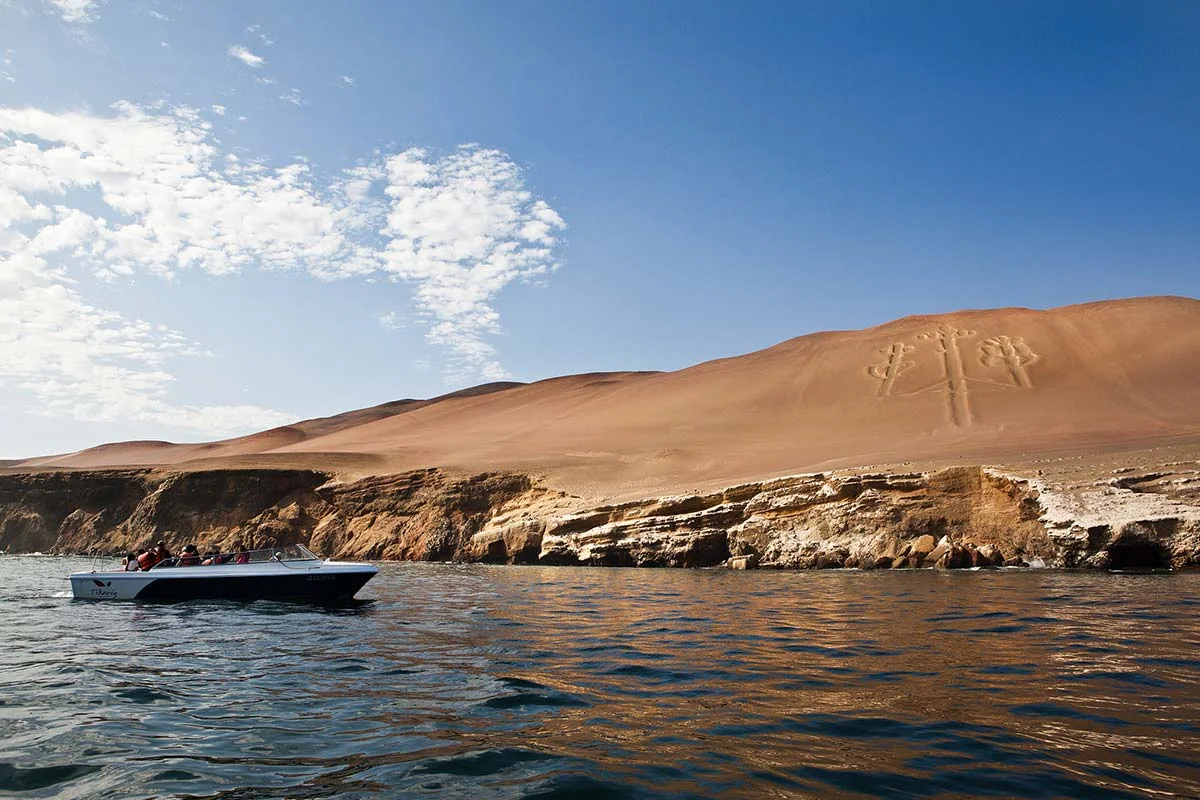
Desert and ocean, a palm-fringed oasis among towering dunes, and the great riddle of the Nazca Lines drawn across the sand. Peru's south coast is the part of the country almost no one expects.
South of Lima the Panamericana runs down a coast of pure desert, sand dunes falling straight into a cold blue Pacific. It is a strange, cinematic landscape, and it holds three of the country's most surprising sights. At Paracas, a wild reserve of red beaches and cliffs sits beside an ocean so rich it has earned the nearby Ballestas Islands the nickname the poor man's Galapagos. Inland at Ica, a single palm-ringed lagoon, Huacachina, hides among enormous dunes where buggies and sandboards fly down the slopes, and old bodegas press the grapes for Peru's national spirit, pisco.
And then there is Nazca, where two thousand years ago a desert people scraped vast figures into the plain, a hummingbird, a monkey, a spider, a condor, lines so large they only resolve from the air. Together this stretch of coast is the great counterpoint to the Andes, warm, low and utterly different, and an easy add-on to a trip through Lima. This is the guide to it.
Three destinations strung along one desert highway, that we link into a private coastal run.
A boat trip among rocky islands swarming with sea lions, Humboldt penguins, pelicans and boobies, the poor man's Galapagos, off the Paracas coast.
A wild desert peninsula where red-sand beaches meet the ocean, with the mysterious Candelabra geoglyph cut into a hillside above the bay.
A real desert oasis, a lagoon and palms encircled by giant dunes, where the thrill is a dune buggy at speed and a sandboard down the slopes at sunset.
Enormous figures and geometric lines etched across the desert two millennia ago, their full scale only revealed from a small plane overhead.
The old bodegas of Ica, where the grapes are pressed for pisco and wine, with tastings of Peru's national drink at the source.
The bleached bones and bright textiles of the Chauchilla cemetery, and the ingenious spiral aqueducts the Nazca built to outlast the drought.
The honest, practical detail for the south coast run.
This is a road trip. The three sit in a line down the Panamericana Sur from Lima, with Paracas around three and a half hours south, Ica and the Huacachina oasis a little beyond, and Nazca roughly six to seven hours out. We run it privately, with a driver and the right stops, so the desert highway becomes part of the experience rather than a slog.
For the Nazca Lines specifically, the famous overflights leave by light aircraft from the aerodromes at Nazca or, more conveniently for many itineraries, Pisco near Paracas, which lets you see the lines without driving the whole way down. We plan the route to suit how much road you want.
This is desert, so it is dry and sunny almost all year and there is no real bad season. The coastal summer, from December to April, is warmest and brightest, ideal for Paracas and the dunes. The cooler months can bring the coastal haze that hangs over this part of Peru, but it rarely stops play.
The one timing tip concerns the Nazca overflight: the desert air is calmest early in the morning and grows bumpier as the day heats up and the wind builds, so we aim for an early flight, which is both smoother and clearer.
The Nazca Lines are the headline, and they are genuinely extraordinary: hundreds of figures and dead-straight lines, some stretching for kilometers, drawn across the desert between roughly two thousand and fifteen hundred years ago and so vast that their shapes only make sense from above. A few of the largest can be glimpsed from a roadside tower, but to truly see them you take a short flight in a light aircraft, banking over the hummingbird, the monkey, the spider and the rest.
A word of honesty: the planes are small and the banking can be bumpy, so if you are prone to motion sickness we plan an early, calm-air flight and can advise on remedies. For most travelers it is a genuine highlight, an unsolved mystery seen with your own eyes.
Two to three days covers the coast comfortably. One full day around Paracas, the Ballestas boat in the morning and the reserve in the afternoon, is lovely on its own. Add Huacachina and the Ica bodegas, and the Nazca overflight, and you have a rich two or three day loop. Because there is no altitude here, it makes a relaxed counterpoint to the highlands, easy to add at the start or end of a Lima stay.
The most comfortable base is Paracas, on the bay, where a small number of proper resorts sit right on the water with pools, spas and sunset views over the Pacific, an unexpectedly relaxing stop. Ica and the oasis offer more rustic charm, and Nazca itself is more of a waypoint than a place to linger. We usually anchor the trip in Paracas and run the rest as day excursions, working across the finest houses on the coast.
A part of Peru best taken privately, at your own pace, with the desert highway as part of the pleasure.
Your own driver and guide down the Panamericana, with the Ballestas, the dunes and the lines woven into a relaxed route, never a rushed bus tour.
An early, calm-air overflight for the smoothest, clearest view of the Nazca figures, with the logistics handled and the nerves eased.
A bay resort to come back to, the Ballestas explored privately, and a sundowner over the Pacific to end the day.
A warm, low-lying counterpoint to the Andes that slots neatly onto a Lima stay, perfect for the start or end of a trip.
The coast pairs naturally with Lima and adds breadth to a classic Peru trip. A few good places to start:
Ica is the home of pisco. Pair the coast with our gastronomy experience for the full story of the grape.
Quiet hours, private archaeologist guides, and luxury suites overlooking the scenery.