






The south of Peru keeps its quieter masterpiece a little out of the way, and most itineraries skip it. They should not. Arequipa is the most elegant city in the country, a White City of pale volcanic stone standing under a ring of perfect volcanoes, and a few hours north of it the Colca Canyon falls away deeper than the Grand Canyon, terraced and farmed and patrolled at dawn by condors. Together they are one of the great journeys in Peru, and the travelers who make the effort almost always count it among their favorites.
It rewards a little time and the right approach, and it pairs naturally with Lake Titicaca to the east, often as the final, unhurried stretch of a southern loop. Here is how we think about both.
Arequipa, the White City
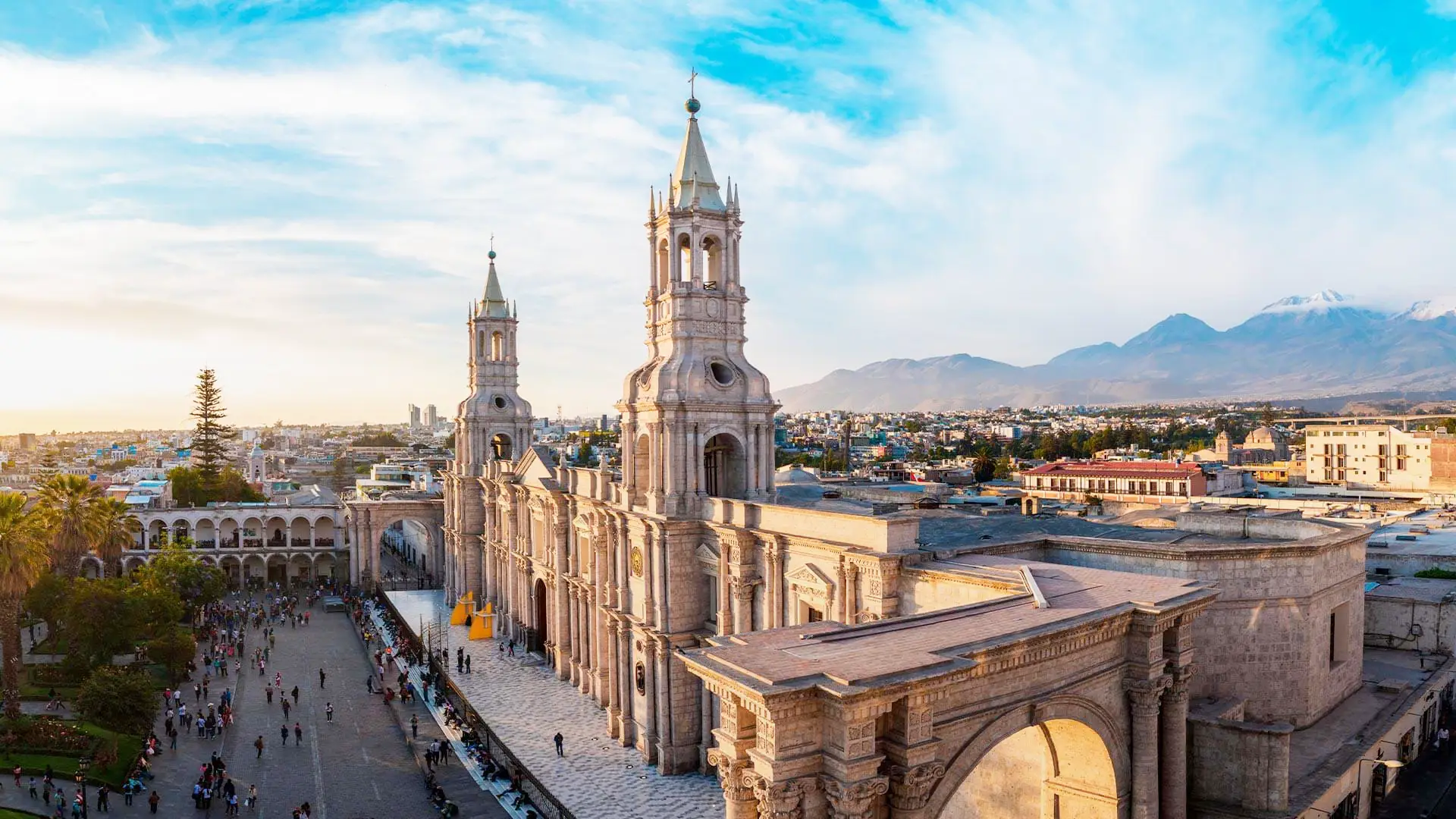
Arequipa is built almost entirely of sillar, the white volcanic stone of the mountains around it, which gives the colonial center a luminous, carved quality found nowhere else in Peru. At its heart is the Santa Catalina Monastery, an entire walled city-within-a-city of ochre and blue lanes, cloisters and courtyards where cloistered nuns lived for centuries, one of the most atmospheric places in the country to wander. The plaza is among the finest on the continent, and the whole city sits in the gaze of El Misti and its sister volcanoes.
Arequipa carries itself with a particular pride, a sense of being its own place apart, and you feel it in the architecture, the museums, the table. We base travelers in the heart of it, often at Cirqa, a restored sixteenth-century sillar convent turned intimate luxury retreat, where you sleep inside the very history you have come to see.
The Colca Canyon
A few hours north and higher up, the land splits open into the Colca, one of the deepest canyons on earth, far deeper than the Grand Canyon, its walls stepped with pre-Inca agricultural terraces that are still farmed by hand today. The villages along its rim, Chivay, Yanque and others, keep traditions and embroidered dress that go back centuries, and the whole valley has a slow, ancient, working beauty quite unlike anywhere else on the route.
In the canyon we stay at Belmond Las Casitas, a scattering of private casitas with their own plunge pools set in gardens above the river, the kind of place where you arrive tired from the drive and altitude and are immediately, completely looked after. There are hot springs in the valley, gentle walks among the terraces, and the great set piece of the canyon waiting for the morning.
The morning of the condors
The reason most people come to the Colca arrives early, and silently. At the Cruz del Condor viewpoint, as the sun warms the canyon walls and the first thermals rise, Andean condors lift off the cliffs and begin to circle, vast birds with wingspans of three meters that ride the rising air without a single beat of their wings, sometimes passing so close overhead you hear the wind through their feathers.
They ride the rising air without a single beat of their wings, sometimes so close you hear the wind through their feathers.
It is one of the genuine wildlife spectacles of South America, and it depends entirely on getting there at the right hour, which means staying in the canyon the night before rather than rushing up from Arequipa. We always arrange it that way, with you at the viewpoint in the still early light before the day groups arrive.
The arequipeno table
Arequipa is also one of the best places to eat in Peru, with a proud regional cuisine quite distinct from Lima's. This is the home of the picanteria, the traditional tavern, and of dishes the city guards jealously: rocoto relleno, the stuffed and roasted hot pepper; chupe de camarones, a rich chowder of river shrimp; ocopa, adobo, and the rest of a deep, spiced, unmistakably arequipeno repertoire. A long lunch in a good picanteria, with the volcanoes in the distance, is one of the quiet pleasures of the south, and a fine counterpoint to the fine dining of the capital that we wrote about in Lima's great tables.
How we do it
Most travelers reach Arequipa by a short flight, though the more memorable arrival is aboard the Andean Explorer across the altiplano from Lake Titicaca. We give the city a night or two and the canyon at least one, we sleep you in the Colca so the condors are an unhurried dawn rather than a dash, and we mind the altitude, since the canyon rim is high and best taken later in a trip. The drive between the two is part of the pleasure, climbing past vicuna country and high lagoons.
Tell us how much time you have for the south, and we will shape the White City and the canyon around you.