






Access
Only by air or river
The largest city on earth you cannot drive to, and the gateway to the northern Amazon, a world of water explored by luxury river cruise into the vast Pacaya-Samiria reserve.
Iquitos is one of the strangest cities in the Americas: a sprawling river port of half a million people, deep in the rainforest, with no road in or out, reachable only by plane or by boat. It boomed a century ago on rubber money, which left it grand tiled mansions and a wrought-iron house said to come from Eiffel, and a floating quarter where whole streets rise and fall with the river. It is the launch point for the northern Amazon.
And the northern Amazon is a different creature from the jungle of the south. Here the river is everything, broad and brown and braided, and you explore it not on foot from a fixed lodge but aboard a small luxury vessel that carries you deep into the Pacaya-Samiria reserve, the largest protected flooded forest in the country. Pink dolphins surface beside the skiffs, monkeys cross the canopy overhead, and the forest mirrors itself in still black water. This is the guide to it.
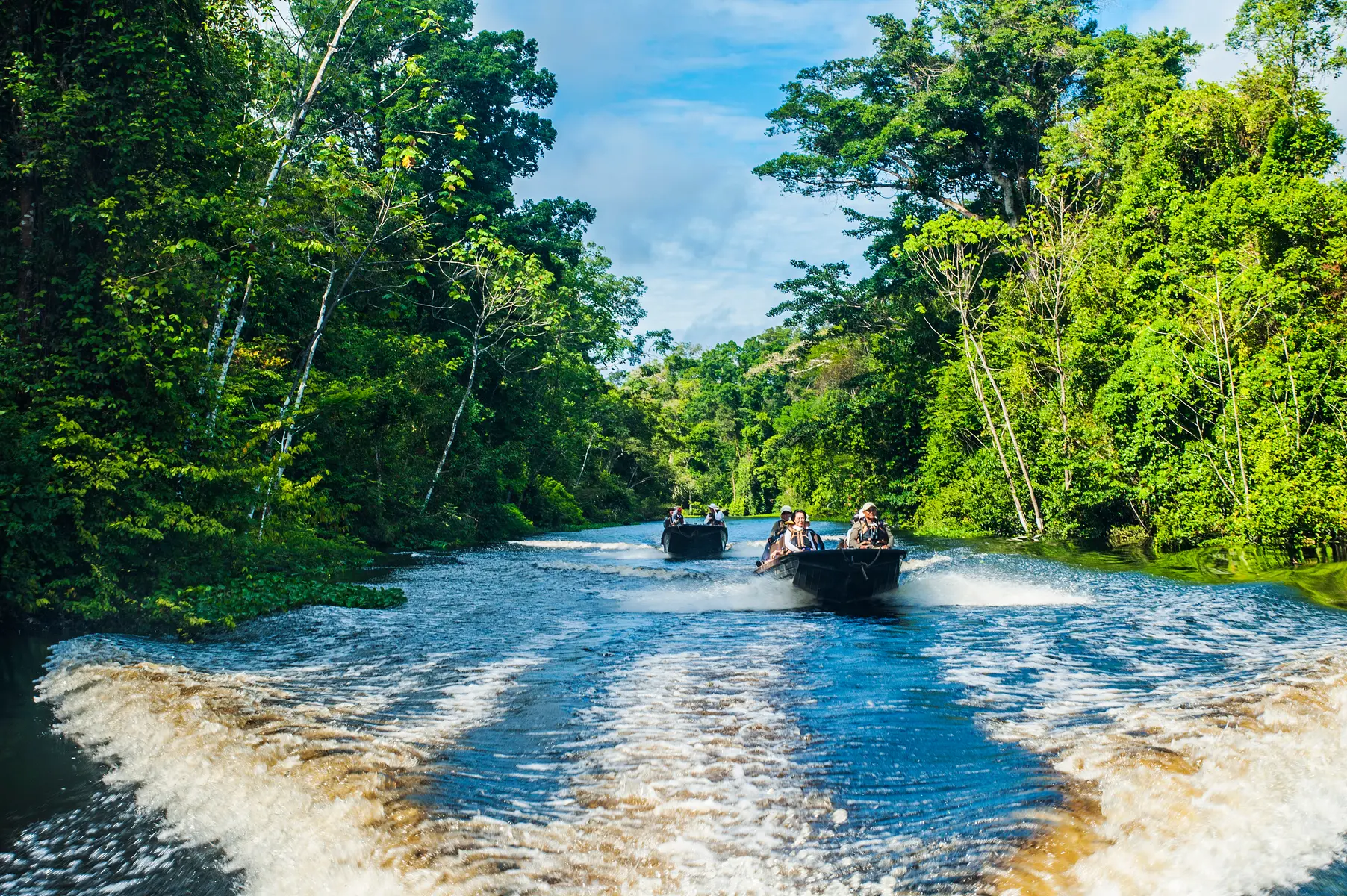
A cruise is a string of skiff excursions into the flooded forest, dawn and dusk, with the vessel as your moving base.
The mirrored forest, the largest protected flooded forest in Peru, two million hectares of channels, lakes and wildlife reached only by water.
The Amazon's famous rose-colored dolphins, surfacing beside the skiffs in the quiet backwaters, alongside their gray cousins.
Small boats slipping up narrow tributaries at first light and dusk, the best wildlife hours, with a naturalist reading the forest as you go.
The rubber-boom city and its floating market quarter, a riotous, water-borne neighborhood often called the Venice of the Amazon.
Giant Victoria water lilies, prehistoric hoatzins, kingfishers and macaws, and black caimans gliding the night water.
Your floating hotel, a small ship of suites and decks and a fine table, carrying you each night to a new stretch of wilderness.
The honest, practical detail for the northern Amazon and its cruises.
Only by air or river, which is the whole charm of the place. The simplest route is to fly from Lima, around two hours over the Andes and out across an endless green plain, with some connections through other cities. There are no roads linking Iquitos to the rest of the country, so the flight is unavoidable and, frankly, part of the adventure.
The cruises embark from Iquitos or from nearby Nauta, where the Maranon and Ucayali rivers meet to form the Amazon proper, and we handle the transfer from the airport to the vessel so the handover is smooth.
The river runs to two seasons. In the high-water months, roughly December to May, the rivers rise and flood the forest, lush and dramatic and best for the dolphins. In the low-water months, roughly June to November, the waters drop to reveal beaches and trails for walking and fishing. Both are wonderful and wildlife is present all year, so the choice is really about what you most want to see. For how the seasons shape a cruise specifically, see our Amazon luxury cruises experience.
This is the destination within the destination. Pacaya-Samiria is the largest protected flooded forest in Peru, a roadless wilderness of some two million hectares where the rivers run clear and dark and the forest is doubled in its reflection, which earns it the name the mirrored forest. It shelters pink and gray dolphins, monkeys, sloths, giant otters, hundreds of bird species and the great paiche fish, and because it can only be reached by water, a cruise is the way in. The further upriver you travel, the wilder and quieter it becomes.
Iquitos itself is worth a little time. The largest city on earth that no road reaches, it grew rich a century ago on the rubber trade, which left it grand tiled mansions, a wrought-iron house said to come from Eiffel, and the floating quarter of Belen, a whole neighborhood that rises and falls with the river and is often called the Venice of the Amazon. It is hot, chaotic and full of character, the human gateway to the wilderness beyond, and most journeys here begin and end in the city or at nearby Nauta, where the great river is born.
Because the reserve can only be reached by water, the way to experience it is a small luxury river ship that carries you deep into the wilderness, repositioning each night so you wake somewhere new. For what cruising is actually like, the vessels and cabins, the cruise lengths and how we choose them, see our Amazon luxury cruises experience, the companion to this place.
A great river cruise is about the right vessel, the right season and the right guide, in that order.
The remote, road-less north handled end to end, the flights, the transfers and the deep-reserve access that get you truly into the wild.
We reach the finest, quietest stretches of the great flooded reserve, far upriver where few travelers ever go.
The rubber-boom city and its floating Belen quarter opened up, not merely passed through on the way to the river.
We thread the northern Amazon onto a wider Peru trip, with every flight and transfer to and from Iquitos handled.
A river cruise pairs beautifully with Cusco and Machu Picchu. A few good places to start:
Prefer a forest lodge over a cruise? See the southern Peruvian Amazon and Tambopata.
Quiet hours, private archaeologist guides, and luxury suites overlooking the scenery.